

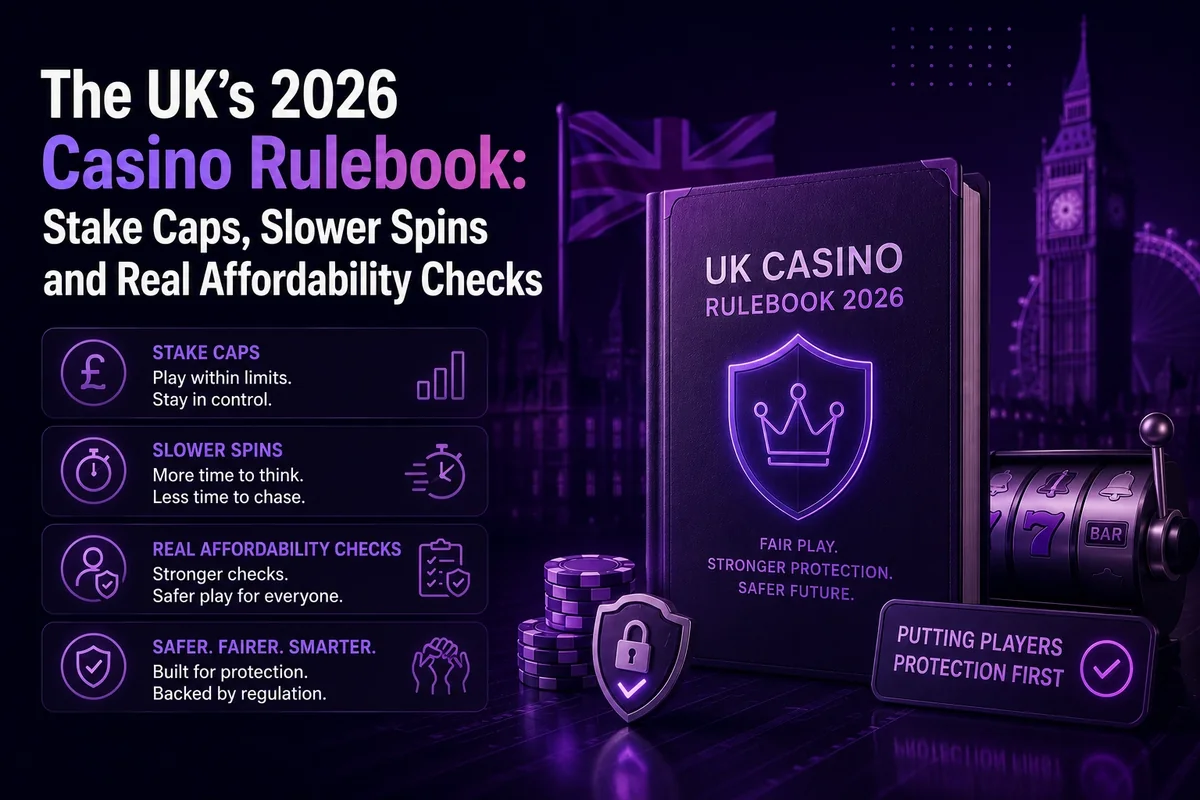
If you play slots in Britain, 2026 is the year the rules finally caught up with the machines. A stack of reforms that regulators spent years arguing over is now live, and together they change how much you can stake, how fast you can spin, and how soon a casino starts asking questions about your money. None of it is subtle, and most of it lands on online slots first.
There's a money story running underneath all of it, too. Since April 2025 every licensed operator has paid a statutory gambling levy, a mandatory charge set between 0.1% and 1.1% of their leviable amount, with online operators sitting at the top of that range. It's due once a year by 1 October, and the cash is ring-fenced for gambling research, prevention and treatment. For the first time the industry is compelled, by law, to help fund the clean-up of its own harm. You won't feel the levy directly, but it's the backdrop to everything below.
New stake caps: £5 a spin, £2 if you're under 25
The headline change is a hard ceiling on online slot stakes. Adults aged 25 and over can now bet a maximum of £5 per spin. Players aged 18 to 24 are capped at £2 per spin, a deliberately lower limit for the age group regulators consider most exposed to fast, heavy losses. The caps apply per spin, not per session, so they throttle the size of any single bet rather than the total you can play through.
In practice, the £5 cap only bites if you were a genuine high-roller; plenty of players never staked that much per spin anyway. The £2 cap for younger adults is the one people notice, and it's there on purpose. If you're in that bracket, no site can quietly let you push past it, and any casino that tries is breaking its licence conditions.
The 2.5-second rule: spins just got slower
Alongside the stake caps, there's now a mandatory minimum gap of 2.5 seconds between slot spins. It sounds trivial. It isn't. Older slots could resolve a spin in under a second, and that speed is a big part of what makes them so easy to play on autopilot for an hour without noticing.
Forcing a 2.5-second breather between spins slows the whole rhythm down. Fewer spins per minute means fewer bets per session and a bit more room to think, "do I actually want to keep going?" You may find your favourite fast slot feels different now. That's the point. The friction is a feature, not a bug.
| Rule | Before 2026 | From 2026 |
|---|---|---|
| Max stake (25+) | No universal cap | £5 per spin |
| Max stake (18-24) | No universal cap | £2 per spin |
| Spin speed | Could be under 1 second | Minimum 2.5-second gap |
| Bonuses | Cross-product allowed | Product-specific only |
| Affordability | Operator's discretion | Light-touch check from £150 net / 30 days |
Affordability checks kick in at £150
This is the change with the most confusion around it, so let's be precise. Light-touch financial-risk checks now begin when your net deposits pass £150 over a rolling 30-day window. That word "net" matters: it's deposits minus withdrawals, not every pound you ever move through an account.
"Light-touch" is the other key phrase. At this level the check is meant to run quietly in the background using publicly available data, more of a soft flag than a demand for three months of bank statements. You shouldn't have to upload payslips to keep playing at £150. The aim is to catch financial distress early without turning every login into an interrogation. If a site asks for heavy documentation at this threshold, that's usually the operator being cautious, not the rule requiring it.
What actually counts toward the £150
Because it is net deposits, withdrawals work in your favour. Deposit £120, win, withdraw £60 and then deposit £40 more, and your net figure is £100, still under the line. The window rolls, too: it is any 30-day period, not a calendar month, so a heavy Saturday does not simply reset on the first. If you would rather not track thresholds at all, a deposit limit you set yourself keeps you comfortably below them and puts you in charge of the number instead of the algorithm.
No more "bet on football to unlock free spins"
Finally, mixed-product bonuses are banned outright. For years a casino could dangle slot free spins that you could only claim after placing a sports bet, or nudge you toward the casino tab to clear a betting offer. That cross-selling is over. Promotions now have to be product-specific: a casino offer for casino play, a sports offer for sports.
It's a genuinely player-friendly change. Those tangled bonuses were designed to move you into products you didn't come for, usually with wagering requirements bolted on. Cleaner, single-product promos are easier to read and much easier to walk away from.
How the reforms stack up over time
None of this arrived in a single day. The reforms landed in stages, and it helps to see them on one timeline so you know what is already binding on your play and what simply funds the wider system.
| When | What changed | Who it affects |
|---|---|---|
| From April 2025 | Statutory gambling levy begins (0.1%-1.1% of leviable amount) | All licensed operators |
| Every 1 October | Annual levy payment falls due | Operators, not players |
| 2026 | £5 and £2 slot stake caps go live | Online slot players |
| 2026 | Mandatory 2.5-second gap between spins | Online slot players |
| 2026 | Light-touch checks from £150 net over 30 days | Higher-spending accounts |
| 2026 | Mixed-product bonuses banned | Anyone claiming promotions |
What it all adds up to
Every one of these reforms points the same way: slower, smaller and safer play, with the industry helping to fund the harm it causes. None of it makes gambling risk-free, but it does tilt the defaults in the player's favour for once. You can see how the new rules land on real sites in our tested UK shortlists.
If you want to see how it plays out in practice, our reviews are built around this rulebook. Start with our guide to UK casinos, dig into the specifics of UK online slots under the new stake caps, or check which new UK casino sites launched already compliant rather than scrambling to catch up.
FAQ
Do the £5 and £2 stake caps apply to table games too?
The per-spin caps target online slots, the fast, repetitive product regulators worried about most. Live and RNG table games run on their own table limits rather than a universal per-bet ceiling. If you mainly play slots, the caps are the change you will feel; if you play blackjack or roulette, check each table's posted limits.
Will I have to upload bank statements at £150?
You should not. The £150 net-deposit trigger is a light-touch check meant to run quietly using publicly available data, more of a soft flag than a document request. If a site demands payslips or statements at that level, that is usually the operator being extra cautious, not the rule requiring it.
What does "net deposits" actually mean?
Deposits minus withdrawals over a rolling 30-day window, not every pound you have ever moved. Taking money out lowers your net figure. That is why the £150 line is more forgiving than it first sounds.
Why do my old favourite slots feel slower now?
Because of the mandatory 2.5-second minimum between spins. Games that once resolved in under a second now pause between rounds. Fewer spins per minute means fewer bets per session, which is exactly the point: the friction gives you a moment to decide whether to keep going.
Can a casino still offer me free spins for a sports bet?
No. Mixed-product bonuses are banned, so a promotion has to stay within its own product: casino offers for casino play, sports offers for sports. The tangled cross-sell deals that pushed you into products you never came for are gone.
Do these rules apply to casinos without a UK licence?
Only UK-licensed operators must follow them. Sites outside that system are not bound by the caps or checks, but they also fall outside the protections and complaint routes the licence provides. For safety, stick to operators licensed for the UK market.
Play responsibly
These rules exist because gambling can cause real harm. It should be fun, never a way to make money or chase losses. If it stops feeling like entertainment, use the deposit limits, cooling-off tools and self-exclusion every licensed casino must offer, or read our responsible gambling guide. 18+ only.